
The ERDF programme in Brussels: €191 million to support 68 projects in response to regional challenges
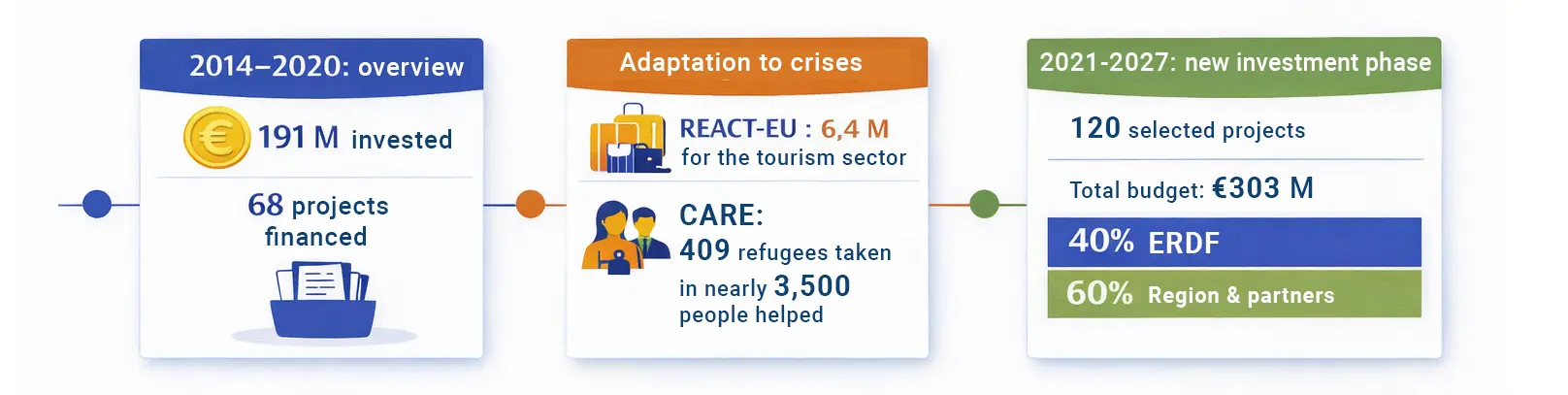
The ERDF, The European Regional Development Fund, presented the results of six years of investment from its 2014-2020 programming period in the Brussels-Capital Region.
These results confirm the importance of this dynamic, which is backed by European financing and implemented in perfect alignment with the regional urban renewal policy
In total, 68 projects received support, including more than 20 infrastructure projects. Around 670 businesses were supported and guided, 7,711 m² were dedicated to businesses, and nearly 400 childcare spaces were created. Research and innovation capacities were enhanced, and primary energy consumption in public buildings was reduced by more than 10 million kWh.

The 2014-2020 ERDF programming period in Brussels
As part of its cohesion and regional development policy, the European Union (EU) has been contributing for many years to the implementation of economic, environmental, and/or social projects for the people of Brussels, through External linkEuropean Regional Development Fund (ERDF)
The 2014-2020 programming period was structured around four priorities: (1) strengthening innovation and research; (2) encouraging entrepreneurship and SME development; (3) supporting the development of a circular economy and the rational use of resources; and (4) tackling social and territorial inequalities.
To ensure maximum effectiveness, the Brussels Region chose to concentrate social investments within the External linkUrban Renewal Area (Zone de rénovation urbaine or ZRU), which brings together struggling Brussels neighbourhoods based on socio-economic criteria representative of deprivation levels. As for economic and environmental infrastructure, projects were developed within strategic hubs defined by the External linkRegional Sustainable Development Plan (PRDD), thereby enabling a comprehensive and coherent approach.
Cohesion and regional development at the heart of investments
By supporting economic, environmental, and social projects, the ERDF programme contributes to a more inclusive, sustainable, and united region, where every resident of Brussels can benefit from the progress made.
The results of the 2014-2020 programming period demonstrate a tangible and measurable impact across the entire Brussels-Capital Region (BCR). Thanks to a coordinated strategy between the ERDF and the BCR, these investments have had a direct and positive impact on the daily lives of its inhabitants.

The Brussels Stock Exchange © Yannick Coppens – SPRB-GOB
An innovation dynamic serving the Region
In the "Innovation and Research" priority axis, the recruitment of 24 new researchers represents a significant increase in regional scientific capacity. This momentum enables Brussels to strengthen its positioning in innovation and expertise, for the benefit of businesses as well as citizens.
Concurrently, the 143 supported businesses cover strategic sectors identified in the regional strategy, such as the digital sector, construction, healthcare, and services. This targeted support directly responds to the economic development and competitiveness objectives set by the BCR.
Finally, 49 collaborations between businesses and research institutions illustrate the commitment to encouraging knowledge transfer and the emergence of innovative solutions tailored to local challenges.
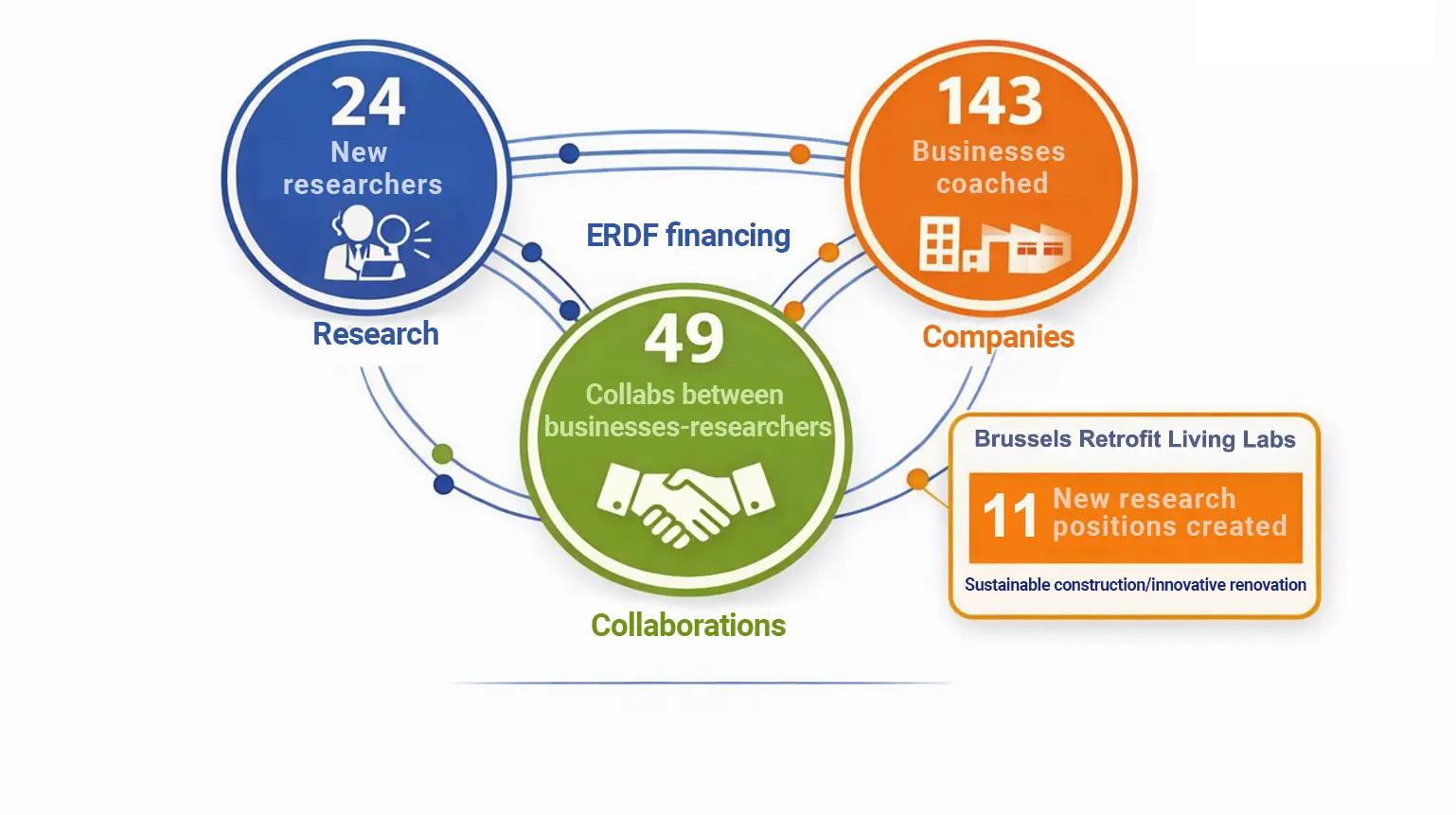
The External linkICITY-RDI.BRU project (a connected technology transfer incubator established by ULB, VUB, Sirris and economic stakeholders) enabled the pooling of academic resources and the integration of talent into Brussels-based companies. Following its success in transforming the digital sector, External linkthe Brussels Retrofit Living Labs project is now tackling sustainable construction. This real-world laboratory created new jobs for 11 researchers and tested innovative renovation concepts. Their incorporation into public policy is a significant step towards sustainable urban development.
Results that exceed expectations: Beyond exceeding the initial targets, these results also demonstrate the dynamic nature of the Brussels ecosystem. The positive impact on research, innovation, and the regional economic fabric confirms the relevance of ERDF investments in supporting the transformation and competitiveness of Brussels.
Economic development and entrepreneurship: structuring, innovating, and creating jobs
Support for entrepreneurship is a key pillar of the ERDF’s efforts. External linkThe renovation of the Stock Exchange in the city centre (12,000 m²), which has become a cultural and tourism hub, is a perfect example of the programme’s ability to reuse heritage buildings and create new economic momentum. Similarly, the construction of the External linkNova City business incubator in Anderlecht (7,600 m²), which is home to more than 60 SMEs, is a good illustration of direct support to innovative businesses and job creation. External linkThe FRAME building – Maison des Médias (9,000 m² gross floor area), the first milestone in the strategic External linkMediapark.brussels, provides a dedicated site for media professionals in addition to enhancing the appeal of the Reyers neighbourhood.
The focus on social entrepreneurship is apparent in the promotion of the External linkCOOPCITY project, whose role in the region’s economic and social transition has already been recognised. Finally, the External linkDev Up Team project has helped to safeguard 1,450 jobs in 11 sheltered workshops across the BCR by promoting the development of new activities and skills.
In quantitative terms, some 560 businesses have received grants, and 166 full-time equivalent (FTE) jobs have been created, among others in healthcare and services. These achievements demonstrate the ERDF’s tangible impact on the business ecosystem of Brussels, fostering innovation, competitiveness, and labour market inclusion.

The Grande Halle Libelco © Séverin Malaud - urban.brussels
Environmental and energy transition: strategic solutions to environmental challenges
To support the BCR in its ecological transition, the ERDF has established itself as a key driver of energy-efficiency refurbishment of public buildings. External linkThe USQUARE project and the renovation of the Vrije Universiteit Brussel, External linkVUB swimming pool, making it the "greenest" pool in Brussels, illustrate how effective these measures are. The project led to a reduction of more than 10 million kWh per year in primary energy consumption in public buildings.
The creation of a geothermal potential map through the External linkBrugeo project provides a scientific basis for the development of renewable energy. Peri-urban agriculture also received financing through the External linkBoeren Bruxsel Paysans pilot project, which promotes the transition to sustainable food systems.
Finally, External linkRecy Park, the new regional recycling centre in Anderlecht, has been operational since the end of 2024 and processes around 5,000 tonnes of waste each year.
These complex projects, which have a significant regional impact, demonstrate the ERDF’s key role in resource management, the fight against waste, and the Region’s adaptation to major environmental challenges.
Social cohesion and inclusion: strengthening the social fabric and access to services
Combating socio-economic inequality and strengthening social cohesion are key objectives of the ERDF.
The permanent move of External linkthe non-profit organisation Zinneke to Place Mazui in Schaerbeek (4,000 m²) provides a permanent space for socialising, creativity and training, contributing to cultural life and local inclusion. In Molenbeek, the renovation of the External linkVaartkapoen (a Flemish community centre) and the organisation of the VK Concerts promote dialogue, training, and voluntary engagement. The centre has become an open and inclusive space for artists and local residents.
Support for External linkiMAL enabled it to double the size of its facilities. This European centrecombines art, science and technology with social inclusion, among others through its Fablab and its efforts to promote the local arts scene.
In response to the shortage of childcare capacity, 400 additional places were created following the construction of six new childcare centres in External linkMolenbeek, External linkAnderlecht and External linkSchaerbeek, meeting the needs of families.
Finally, thanks to support from the ERDF and the Brussels-Capital Region, External linkMédecins du Monde established two External linkintegrated social and health centres for migrants, the homeless, and families in precarious circumstances. In addition to providing a practical response to the humanitarian crisis, they also improve access to healthcare for the most vulnerable groups.
These initiatives demonstrate the ERDF’s commitment to a more inclusive, cohesive and resilient society.
A multidimensional and complementary capacity for action
All of these projects, which received support from the ERDF in Brussels, demonstrate the programme’s ability to operate simultaneously on several fronts, combining economic development, the green transition, and the strengthening of the social fabric.
This comprehensive and complementary approach makes it possible to tackle the region’s specific challenges while promoting the diversity of initiatives and ensuring strategic coherence in public policy. The ERDF is thus establishing itself as an essential tool for structuring the region, stimulating innovation, and promoting an inclusive and sustainable society.
Dealing with crises
The European Union’s cohesion policy has been adapted in response to the COVID-19 pandemic and the war in Ukraine.
The Brussels ERDF Programme was strengthened through External linkREACT-EU (funding for recovery, the green and digital transition, and social support, including €6.4 million for tourism businesses) as well as External linkCARE (support for the integration of Ukrainian refugees), which paved the way for the reception of 409 refugees in Brussels out of nearly 3,500 people receiving regional support.
2021–2027 programming period
At the end of the 2014–2020 programming period, the ERDF’s objectives were achieved.
External linkThe 2021–2027 programme is currently underway and is making full use of its resources to achieve its objectives. To date, 120 projects have been selected to promote the ecological and digital transition, boost economic innovation, strengthen social cohesion, and improve the quality of life in Brussels through structural investments. This programme has a total budget of €303 million, 40% of which (€121 million) is funded by the ERDF, and 60% by the BCR and its partners.