17%
In ten years the mass of newly registered cars in the Brussels Capital Region (BCR) increased by 17%.
1,681kg
The average weight of newly registered cars in 2023 conceals disparities in vehicle weight according to income levels.
+37.2%
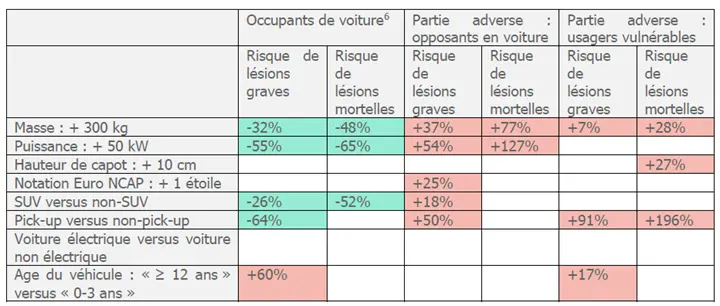
For occupants of a car involved in a collision with another vehicle weighing over 300 kg more, the increased mass of the opposing vehicle substantially raises the risk of severe injury (+37.2%) and, to an even greater extent, the risk of fatality (+76.6%)
+180cm
Since 2018 more than half of new cars registered in Belgium exceeds 180 cm in width.
33,818
New registrations in BCR in 2023 were SUVs, accounting for more than half of the total.
14%
Newly registered electric cars in Belgium are, on average, 14% heavier than the European Union average.
25%
of newly registered cars in the Brussels-Capital Region were electric in 2023
82.5%
all car trips made by Brussels residents are within the scope of light intermediate vehicles.
600kg
For a vehicle is achievable.
Heavier cars
Between 2013 and 2023, the mass of newly registered cars in the Brussels Capital Region (BCR) increased by 10% for private cars and by 17% for cars registered by an enterprise (which include company cars). The company cars are significantly heavier (1,711 kg) than recently registered private cars (1,463 kg).
As the share of enterprise-registered vehicles increased over this period, the average weight of newly registered cars in the Brussels-Capital Region rose by 17% between 2013 and 2023, reaching 1,681 kg. This trend is not specific to the Brussels Region. In fact, vehicle weight has increased significantly across Belgium, with the national rise exceeding even the EU average. Privately owned vehicles in Brussels households are considerably lighter than company cars. Indeed, only 15.6% of the private fleet exceeds 1,600 kg, compared to 41.5% of the corporate fleet.
Heavier cars based on incomes
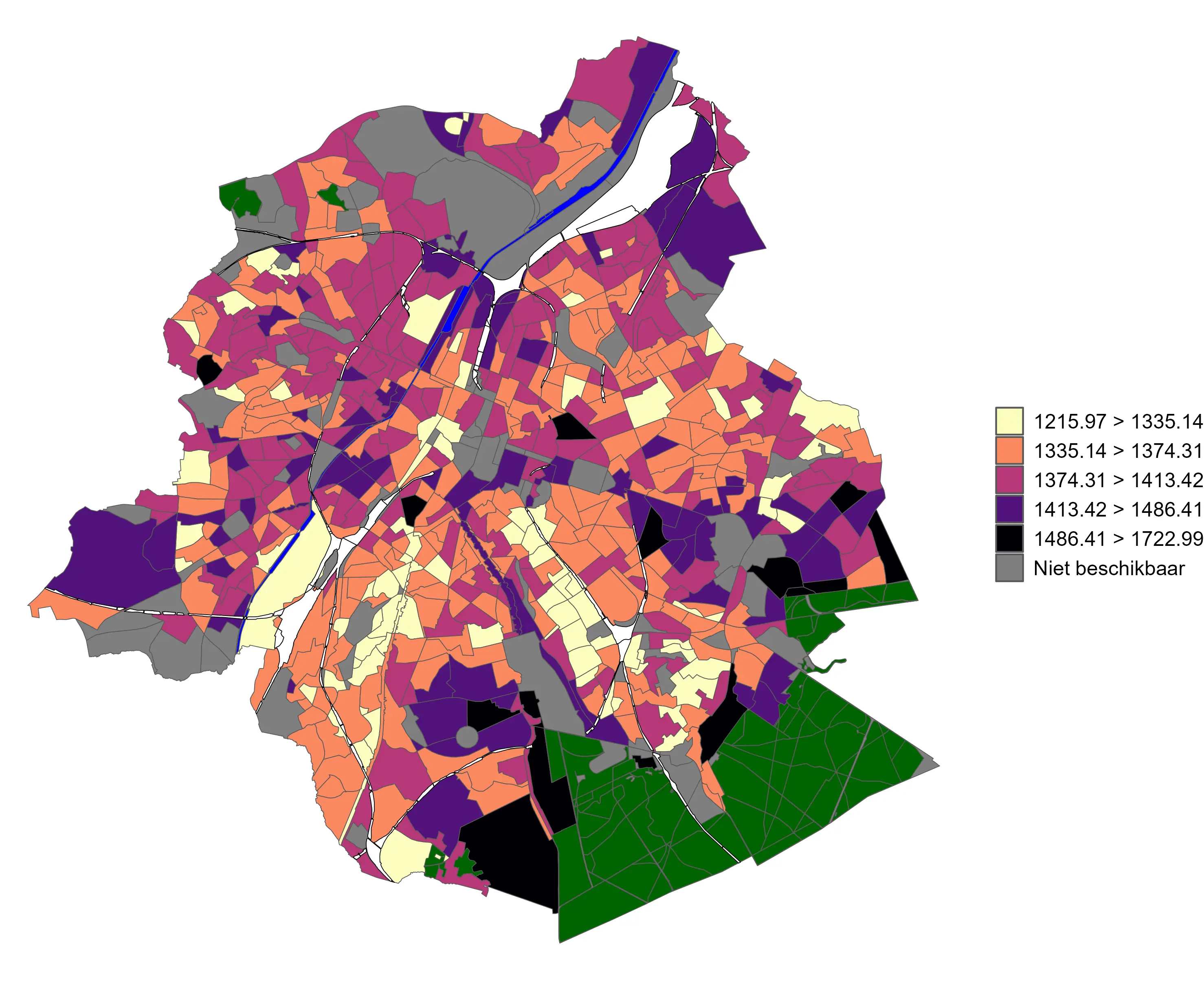
Company cars represent a fringe benefit predominantly enjoyed by households with (very) high socio-economic status. Moreover, these vehicles are significantly heavier (1,711 kg) than newly registered private cars (1,463 kg). In 2023, the average weight of newly registered cars in the Brussels-Capital Region reached 1,681 kg.
As illustrated by the map showing the distribution of average car weight by statistical sector among Brussels residents, the southeast periphery stands out, where socio-economic indices are much higher than elsewhere in the Region, and where the majority of households owning company cars reside. The northwest part of the region also exhibits elevated, though not maximal, values. These neighbourhoods have a higher-than-average number of households with children, and motorized households there are more frequently families with children. Indeed, as noted earlier, couples with children tend to own heavier cars than other household types.
Two-speed safety
Based on a statistical analysis covering the whole of Belgium, Vias recently demonstrated that heavier, taller and more powerful cars lead to “two-speed” safety. While the probability of being seriously injured or killed decreases for the occupants of a heavier vehicle, the same probability increases for the other road users, of the vulnerable variety (pedestrians, cyclists, motorcyclists) or occupants of a smaller car.
Brussels Mobility has replicated Vias’ analysis for the accidents that occurred in the Brussels Capital Region between 2021 and 2022. Even in our urban environment, where the 30 km/h speed limit is the norm on most of the roads, the weight of vehicles seems a major factor in accidents. For the occupants of the other vehicle involved, the effects were even greater in the Brussels Capital Region than for Belgium as a whole. The increasing weight of vehicles therefore compromises the objective of reducing to zero the number of deaths and serious injuries in Brussels by 2030.
Wider and wider
Cars are occupying an increasing amount of public space. New cars registered in Belgium since 2018 are on average over 180 cm in width (excluding mirrors). Vehicles of this size do not fit into many parking spaces on-street and off-street.
SUVification of Cars
The Brussels-Capital Region is also experiencing a steady increase in the proportion of SUVs. In 2023, more than half of all new car registrations were cars of this type amounting to 33,818 vehicles.
The number of second-hand SUVs registered is also on the rise, reaching over 10,000 (19.5%) in 2023. The evolution of the share of SUVs in new registrations shows little variation depending on the owner. However, there is a significant difference when it comes to the share of SUVs in the total Brussels fleet: it stands at 18.4% for private cars, 44.2% for leased vehicles, and 32.7% for vehicles registered by other enterprises.
Electric cars heavier than in other European Member States
Electric motors alone only partly explain the increase in the weight of Brussels' vehicle fleet. It is also due to the fact that it is mainly the high-end segments of the car market that are being electrified. This situation has a double impact on the weight of cars: on the one hand, these models are heavier in themselves and, on the other hand, they have heavier batteries (around 500 kg) to compensate for higher energy consumption and to ensure greater autonomy.
The Belgian tax system favours company cars without distinguishing between models, This explains why newly registered electric cars in Belgium are on average 14% heavier than the EU average and are more expensive, more powerful, larger and heavier than in neighbouring countries.
Light intermediate vehicles lighter than conventional cars
Light intermediate vehicles (LIVs) are an emerging class of light vehicles between the bicycle and the car, with many comparative advantages over the latter. They are lighter, cheaper, more efficient, less polluting and offer numerous advantages over conventional cars. Following on from ADEME's External linkExtrême Défi in France, Brussels Mobility has conducted a study to explore the potential of these light electric vehicles for mobility in the Brussels-Capital Region and to formulate recommendations.
📓
Larger and heavier cars, analysis of the situation and possible measures (full report in French).
📓
Executive summary of the study "Larger and heavier cars, analysis of the situation and possible measures"
📓
The executive summary of the study “Light intermediate vehicles in the Brussels Capital Region can be found here”
📓
Light intermediate vehicles in the Brussels Capital Region (full report in French)